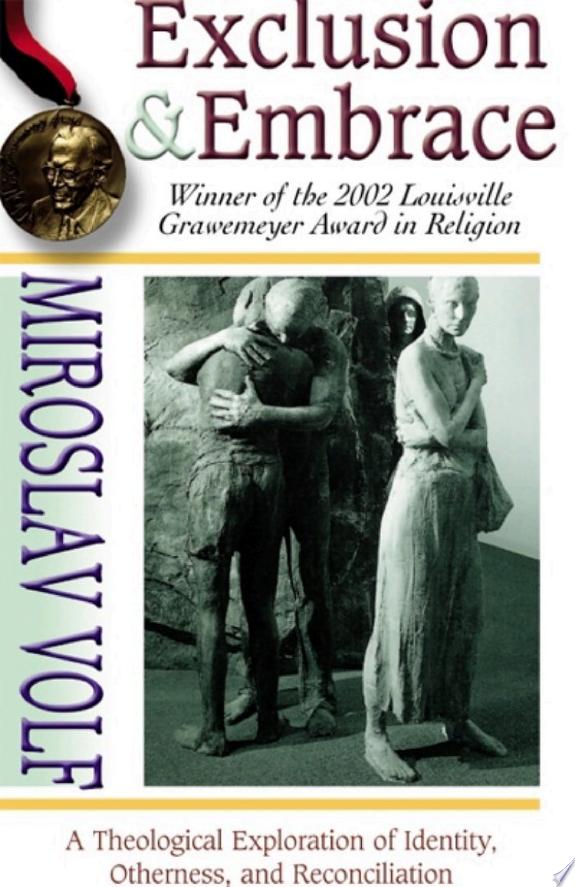
Exclusion and Embrace
Embed this book card on your site
Publisher description
Life at the end of the twentieth century presents us with a disturbing reality. Otherness, the simple fact of being different in some way, has come to be defined as in and of itself evil. Miroslav Volf contends that if the healing word of the gospel is to be heard today, Christian theology must find ways of speaking that address the hatred of the other. Reaching back to the New Testament metaphor of salvation as reconciliation, Volf proposes the idea of embrace as a theological response to the problem of exclusion. Increasingly we see that exclusion has become the primary sin, skewing our perceptions of reality and causing us to react out of fear and anger to all those who are not within our (ever-narrowing) circle. In light of this, Christians must learn that salvation comes, not only as we are reconciled to God, and not only as we "learn to live with one another," but as we take the dangerous and costly step of opening ourselves to the other, of enfolding him or her in the same embrace with which we have been enfolded by God. Is there any hope of embracing our enemies? Of opening the door to reconciliation? Miroslav Volf, a Yale University theologian, has won the 2002 Louisville Grawemeyer Award in Religion for his book, Exclusion & Embrace: A Theological Exploration of Identity, Otherness, and Reconciliation (Abingdon, 1996). Volf argues that "exclusion" of people who are alien or different is among the most intractable problems in the world today. He writes, "It may not be too much to claim that the future of our world will depend on how we deal with identity and difference. The issue is urgent. The ghettos and battlefields throughout the world--in the living rooms, in inner cities, or on the mountain ranges--testify indisputably to its importance." A Croatian by birth, Volf takes as a starting point for his analysis the recent civil war and "ethnic cleansing" in the former Yugoslavia, but he readily finds other examples of cultural, ethnic, and racial conflict
Description provided by Google Books